jeudi 7 avril 2011

Let’s Not and Say We Did


Wayne Spencer’s call for the formation of a “new Situationist International” (5 March 2010) is an embarrassment. It embodies everything that is wrong with post-situationist thought, and I wouldn’t blame anyone if they dismissed that thought on the basis of it.
Towards a New Situationist International is wrong about the proletariat: the “defining quality of proletarian life” is not “a craven acceptance of the separate commodity economy and the state as unchangeable givens” (Spencer’s thesis #1), but a constant struggle to make a living in an unlivable world. Spencer’s attention is on ideology, not socio-economic conditions, and -- with respect to the proletariat -- he places himself outside of it, as a nay-sayer to its "craven" acceptance, not inside, as an inmate in the same prison.
His text is wrong about the current state of the class struggle: the “discontent with the petty and idiotic lives” that we are obliged to lead is not “buried” (thesis #2), but front-page news: the student occupations movement in America; the on-going rioting and social strife in Greece; the popular demonstrations against the government in Iceland; the social movements in France against detention centers and expulsions; et al. Spencer speaks of a world that was destroyed more than 40 years ago.
His text is wrong about the current state of critical theory: “revolutionary theory” has not “almost completely failed to keep abreast of developments within advanced capitalism” (thesis #3); it is incorrect to say “revolutionary theory and practice stands at present in a state of perfectly scandalous dereliction” (thesis #6). In point of fact, since the dissolution of the SI, revolutionary theory has gone on to produce useful critiques of artificial terrorism, nuclear power, and political sovereignty, as well as such useful concepts as biopolitics, deterritorialization, and the integrated spectacle. Spencer speaks as if revolutionary theory stopped cold in 1972, which of course would come as a surprise (or insult) to Guy Debord, the ex-situationist who continued to develop “situationist” theory well after the SI dissolved and who personally associated with at least one other major critical theorist of the era (Giorgio Agamben). As for revolutionary practice, which Spencer hardly mentions, the revolutionary movement has produced tactics that were unknown before 1972: Black Blocs, flashmobs, and computer viruses, among many others.
His text is wrong about the situationists: one cannot speak of “the thought” of the SI, as Spencer does (thesis #4), because that “thought” changed several times between 1957 and 1972: after Debord’s contact with Socialisme ou Barbarie in 1960 (the theme of workers councils); after the admission of Raoul Vaneigem in 1961 (the critique of everyday life); after the break with Henri Lefebvre in 1963 (the abandonment of unitary urbanism); after the admission of young revolutionaries and anarchists in 1966 and then again in 1968 (the emphasis on student life, occupations and general assemblies); and, of course, after the birth of the “pro-situ” phenomenon (the critique of the cadre). Spencer speaks as if everyone understands what “situationist theory” is, but he himself fails to outline its basic principles.
His text is wrong about post-situationists: “situationist thought” has not been “abandoned by individuals with revolutionary intent” (thesis #5). It certainly hasn’t been “abandoned” by ex-situs such as Raoul Vaneigem, Jacqueline de Jong, Donald Nicholson-Smith, and T.J. Clark, or by first-generation pro-situs such as Michel Bounan, Ken Knabb and Michel Prigent (not to mention yours truly, who accounts himself a second-generation pro-situ). Spencer makes no mention of the French anarchist website Jura Libertaire: it consistently mixes together news items about current anti-capitalist and/or anti-state actions with situationist texts from long ago. The situationists are also dear to those (do not doubt their “revolutionary intent”!) who maintain the websites called Les Amis des Nemesis, Jules Bonnot de la Bande, and Debord-Encore. Spencer writes as if he doesn’t read any other language than English. (Was his text translated into any other language? Not even French?! How “international” can this be?)
His text is anti-situationist when it comes to matters of organization: the SI never allowed its members the abilities to carry out “theoretical and other practical actions […] in the individual names of those who produce them, and on their responsibility alone” and/or “carry out projects outside the framework of the international and to form other associations to do so” (thesis #7). Spencer writes as if he wants to found an organization that is “situationist” in name only, no matter how well he recites certain catechisms (thesis #8).
Last, but not least, his text is worse than a monologue: it is a sterile dialogue with himself (“it might be objected that such a proposal”; “it might also be objected”; “if I fail to heed these weighty objections”) (thesis #9). This echoes Spencer’s own situation: not a member of any organization, no matter how small, but an isolated individual. It is easy to foresee what would take place at a “conference between interested parties” that was based upon written answers to Spencer’s five questions, so much so that a face-to-face meeting wouldn’t be necessary (or so he claims): there would be a deluge of useless paper. Everyone would read what had been written and submitted, sure. But who would judge what was good and what was bad? Spencer himself? Note well his sudden recourse to the word “we” when the subject of whom to “exclud[e] from the outset” comes up. “We might save ourselves a little time by excluding from the outset anyone who . . .” (thesis #10). I have a better idea. Let’s exclude from the outset anyone who would exclude anyone from the outset.
Bill Not Bored 16 March 2010


On 23 March 2010, I received a lengthy reply from Wayne Spencer. Its conclusion is the following critique, which I reproduce without comment.
"No doubt Bill Bored can be assured that he is not speaking to himself. He presents his work at galleries. He lectures at subsidized cultural events. He speaks to the press and appears in documentary films. He leads walks. He stages plays and displays placards before passers-by and surveillance camera workers. He complains that his civil liberties are not upheld. He translates and comments. But after 25 or so years of presenting tepid social critique to spectators who have evinced no practical dissatisfaction and passively view his activities with no practical revolutionary purpose in view, nothing in the way of revolutionary contestation has been achieved. His efforts do not disrupt the processes by which his own life becomes foreign to him, however briefly. Nor do they attack the processes by which his audiences' lives become foreign to them. Yet he continues untroubled by the compatibility of what he does with the persistence of the society of alienation and takes no steps to turn against his palpably inadequate praxis. Indeed, he seems quite content with the cultural and pseudo-oppositional niche he has found within that society. For him, it seems, revolution is a process that is satisfactorily unfolding at some distance from the everyday life around him and will one day deliver salvation to his door. All this is very different from the views that prompted my proposal for a new international association of situationist revolutionaries. It is no surprise that Not Bored views that proposal with contempt."

Azote dans le réacteur n°1 de Fukushima


Fuite bouchée, mais risque d'explosion d'hydrogène dans le réacteur n°1. La situation évolue dans la centrale nucléaire de Fukushima, mais dans des directions différentes en fonction des multiples facettes de cet accident nucléaire. L'injection de silicate de sodium dans les sous-sol du réacteur n°2 a fini par boucher les trous et fissures par lesquels s'écoulait une eau très radioactive et qui allait jusqu'à la mer. Des mesures de radioactivité en mer ont montré que la contamination atteignait des niveaux très élevés. Le point d'observation de la fuite, dans une fosse technique, a d'abord montré une diminution du débit, puis un arrêt complet.  
Toutefois, il ne faut pas en conclure que l'océan ne reçoit plus d'eau radioactive. En effet, les Japonais déversent environ 400 tonnes d'eau par jour sur le site, soit par injection dans les trois réacteurs pour les maintenir à température (entre 6 et 9 tonnes par heure),  soit par projection d'eau sur le réacteur 3 et les piscines à combustibles usés des réacteurs 1 et 4 dont les circuits de circulation d'eau n'ont pas été rétablis, à la différence des piscines à combustibles usés des réacteurs 2 et 3. Ces 400 tonnes d'eau sont à "circuit ouvert"... autrement dit, elles coulent ensuite vers les parties basses du site. 
Sur le réacteur n°1, les ingénieurs et techniciens ont commencé à injecter de l'azote liquide dans la cuve du réacteur. Cette injection d'un gaz neutre vise à écarter la menace d'une explosion d'hydrogène. De telles explosions ont eu lieu au début de l'accident dans les réacteurs 1, 3 et 4 et ont détruit le haut des bâtiments. 
Sur le front de la contamination, l'attention s'est portée sur les espaces de sur-contamination détectés   dans la zone de 20 à 30 km où l'évacuation n'a pas été obligatoire, même si de nombreuses personnes et familles l'ont quittée. Dans plusieurs villages, on frôle ou dépasse les limites prévues pour une évacuation, qui sont d'un équivalent de 50 millisieverts par an. La Commission pour la sécurité nucléaire du Japon vient d'émettre l'avis de descendre ce niveau à 20 millisieverts par an. De ce fait, certaines localités devraient être évacuées dans cette zone, car la prolongation de l'accident oblige à prendre en considération la poursuite de la contamination. Il est vrai que si l'on observe plus des émissions massives comme aux premiers jours, elles ne sont pas stoppées, et rien ne permet d'espérer qu'elle le  seront rapidement. 
Enfin, une seconde détection de traces de plutonium a été réalisée sur le site, en plusieurs endroits. La quantité est faible - 0,26 becquerels par kilogramme de sol - et comparable à celle laissée par les essais d'armes nucléaires des années 1960, mais indique probablement une fuite d'un des réacteurs en raison de sa composition isotopique particulière, différente de celles des armes.
La CRIIRAD a reçu plus d’un millier de demandes concernant l’impact de l’arrivée sur la France des masses d’air contaminé : quels sont les risques pour ma santé ? Pour mes enfants ? Pour l’enfant que je porte ? Faut-il se protéger ? Si oui, comment ?
Cartes de France: 1. Activité de l'iode 131 dans l'air (904 ko - pdf) 

mercredi 6 avril 2011

Guy Debord in 2009: Spinning or Laughing?

an opinion
Guy Debord wasn't buried. Following his wishes, his remains were cremated and scattered into the wind over a beloved Quay in Paris. The gesture couldn't be clearer: no place to come to worship his memory, to mark significant anniversaries or to leave tokens of appreciation. A refusal of eternity and "posterity"; an emphatic embrace of the ephemeral and disappearance(s). And so one can't say "Guy Debord is probably spinning in his grave" or "Guy Debord is probably laughing in his grave." But the question can still be raised. Fifteen years after he committed suicide at the age of 62: is Guy Debord, now in heaven or hell, spinning or laughing?
He's gotta be doing something, something other than resting peacefully. He has not been forgotten; he has not achieved oblivion. On the one hand, his works continue to inspire and motivate people: his 1950s-era notions and practices of psychogeography and urban drifting (la derive) continue to be popular, especially among urban theorists and contemporary performance artists; his chess-like cabinet game from 1977 (aka Kriegspiel or The Game of War) has become fairly popular among programmers and players of digital games in England and the USA; and his critique of the society of the spectacle (aka "the Spectacle") continues to be adopted as a starting point by young revolutionaries in France (cf. Tiqqun and The Coming Insurrection).
On the other hand, Debord's works have been repackaged and sold by his second wife, Alice Becker-Ho. Over the course of the last 15 years, "Ms Debord" has chosen to distribute her late husband's films in DVD form through Gaumont, a large and well-established producer and distributor of spectacular entertainment; to publish her late husband's "complete" correspondence in abridged form through Fayard, a subsidiary of a large arms manufacturer; and to sell his complete archives to either the Bibliotheque Nationale de France (BNF) or the Beinecke Library at Yale University, whichever can come up with $2.34 million by 2011. "Ms Debord" has also used her commercial and legal clout to either change the presentation or completely suppress the "unauthorized" usage of her late husband's works by the Radical Software Group (re: The Game of War) and Jean-Francois Martos (re: Correspondance avec Guy Debord), neither of which came close to actually competing with the "official" copyrighted products. Were either of these heavy-handed actions really necessary? They certainly generated a ton of negative press for Alice.
I grant that her conduct could have been (even) worse. After all, she could have written books or appeared in the movies or the mass media to extoll the virtues of her late husband. She could have licensed his image for use in an advertising campaign . . . "Spectacular eyeglasses," or some such. She hasn't, of course. Nevertheless, she has conducted herself like a classic recuperator. Would Guy agree? What would he think? Intriguing questions, n'est pas? I don't know what the answers would be, of course: I never met or corresponded with him; I am not in communication with either his ghost or his spirit; I have simply translated a bunch of his writings, especially his letters. And so, I can only make an "educated guess."
I would say -- all things considered, contrary to what others seem to think and despite what I personally might want or like -- Guy Debord would have approved of it all, not just the "good" things (inspiring yet another generation of young people), but the "bad" (capitalist) things, as well. He would have found no contradiction between these two developments or, rather, he would have seen the contradiction between them in a positive light. His approval would of course be a matter of supporting everything that his wife and companion for the last 30 years of his life would do "in his name" -- only she knows what his real wishes and intentions were -- but also an affirmation that these would have been the precise things that he himself would have done, had he been alive. In short, Alice isn't to blame for the weird repackaging of Guy Debord's works; Guy himself is.
I say this despite the fact that "Ms Debord's" recent conduct -- appearing in public and hobnobbing with high-level governments officials, wealthy patrons, and literary celebrities like Phillipe Sollers so as to "raise money" for the BNF, or appearing alongside Jacqueline de Jong and allowing herself to be misidentified as a "member of the Situationist International" in the publicity for an art opening at Yale University -- would have appalled her late husband, who detested celebrity and avoided celebrities, and had a mania for correcting "small" factual mistakes concerning membership in the Situationist International. She certainly would have done none of these things when he was alive. Though Guy had been litigious, he never sued a publisher of a "pirate" or copyright-infringing edition of his works. Though he allowed his works (both the new and the old ones) to be published by Gallimard, he did so provisionally, in response to a specific situation, and was ready to "jump ship" at any moment. And though he himself had created, organized and made plans for the eventual disposition of his archives, he would certainly have been mortified by the idea that the French government, in a fairly mysterious attempt to keep those archives in France, would declare them a "national treasure." Guy detested literary prizes and would certainly have hated the explicitly anti-May 1968 politics of the very French government (the Sarkozy gang) that has miraculously deemed his archives to be worthy of such great distinction.
Guy Debord was a very complicated person. While he was alive, he -- he and Alice, as a matter of fact -- were supporters, organizers and beneficiaries of various kinds of scams. According to his own Panegyric, he was a thief in his youth. In the 1950s and 1960s, Debord and his first wife, Michelle Bernstein, made a little "easy" money by publishing cheap novelties (a horoscope for racehorses, a superficial novel about the depths of the "existentialist" scene, etc.). In a letter to Gianfranco Sanguinetti dated 26 October 1975, Debord referred to this kind of enterprise as "shit crushing": crushing shit and getting money as a result. For example: claiming to the Italian government that one's ships were destroyed during World War II and that one is therefore entitled to financial compensation. In August 1993, Debord justified the publication and sale of Memoires (originally produced as a gift to its recipients) in the following manner: "It was a gift, but now it must cease to be one [...] In sum, I prefer to sell my prestige and to recoup my losses with suitable liquid compensations."
The greatest emblem of this side of Guy Debord is the cover of his post-humous book, Des Contrats (1995), which was designed in accordance with Debord's own wishes. It shows "the Street Acrobat" (Le Bateleur), which is a card in the Marseille Tarot deck. In one of the last letters he ever wrote, Debord explains that this image is "the most mysterious and the most beautiful, in my sense of these words [...] It seems to me that this card will add, and without the duty to imply it too strongly, something that one could see as a certain mastery of manipulation, and will do so by opportunely recalling the extent of its mystery" (letter to Georges Monti). The "mystery" of truly masterful manipulation is that it achieves its intended effects without any apparent effort, without the manipulation ever being detectable, not to mention obvious. But then, if the manipulation is indeed undetectable, how do you know it is really there? In the Tarot card: note the deceptive simplicity of the Acrobat's movements.
Of course it isn't quite clear who was being manipulated in the pages of the Contrats. Was it Gerard Lebovici, Debord's patron in the 1970s and the co-signatory of his film contracts? Or was it Lebovici's heirs, with whom Debord had broken off both commercial and personal dealings in the early 1990s? I believe it was the latter. In 1992, Editions Lebovici had been forced to turn the rights to Debord's films over to Debord himself. Perhaps the Contracts book (and its Tarot-card-cover) were ways of signaling Editions Lebovici that they had been "manipulated" because they had failed to realize that, even though Debord's films had not been screened since 1984, the texts surrounding them (the film contracts, in this case) could be commercially exploited.
How could someone like Debord be devoted to "the objective truth" of the dialectic and History, and committed to the practice of "transparency" by and within revolutionary organizations, and yet still be a mysterious master of manipulation? Properly answered, it seems, this question is not a matter of ethics (the rhetorical demand/condemnation "How could you do that!"), but a question of practicality ("How did you do that?"). It is, of course, tempting to break Debord's "career" into parts, with -- inevitably -- the good parts coming early and the bad parts later on. With greater or lesser justification, people have said the "break" came in 1962, with "the expulsion" of "the artists" from the SI; in 1971, with the end of the SI; in 1975, with the appearance of the first-person "I" in his films; in 1984, with the murder of Gerard Lebovici; in 1988, with the publication of Comments on the Society of the Spectacle; or in 1990, with the on-set of chronic health problems. All were turning points, but "breaks"? I'm not sure.
And so let say this: during his lifetime, Guy Debord managed to juggle a lot of objects of different kinds; his genius was his ability to (attempt to) retrospectively demonstrate the consistency of his movements. The Preface to the 4th Italian Edition of "The Society of the Spectacle (1979), Considerations on the Assassination of Gerard Lebovici (1985), Comments on the Society of the Spectacle (1988), Panegyric (1989), and Preface to the Third French Edition of "The Society of the Spectacle" (1992) are all true feats of intellectual acrobatics. In each case, Debord shows that there had been no contradictions, no real contradictions, in the sense that he had never come to a halt or been stopped en route; at every turn, he'd found a way out. The line from 1952 to 1994 was surely irregular and meandering, but it was unbroken. But what happens after 1994, when the line must continue (the "legacy" must be protected, the Show must go on) despite and yet because of the death of The Acrobat himself? The answer is obvious: another acrobat must be found who can "step in" and keep the acrobatic feat going.
But why does the Show have to go on? What would it mean for the "Debord Show" to stop? Instead of being repackaged (sold piecemeal or en bloc), his archives could be donated to, say, the Institute for Social Research in Amsterdam, the Beinecke Rare Books Library at Yale University or the French National Library -- someplace open to the public. The Debord estate could receive the appropriate tax deductions and write-offs, plus whatever it might make as sole copyright holder from the sales of individual components of the archives (Debord's films, film scripts, film contracts, essays, song lyrics, translations, books, letters, posters, audio recordings, paintings, etc.). That would be a lot of money, obviously; perhaps as much as $2.34 million. The estate would be free to make as much money as it wished, provided that the contents of the thing(s) being sold were complete and unabridged, and that the producers/distributors of the item(s) -- the truly complete correspondence of Guy Debord, for example -- were either independent or non-profit entities.
As things stand today, Alice Becker-Ho, doing as she pleases, will make a great deal of money in the coming years, perhaps much more than $2.34 million. I do not think it too much to ask, "Where is all that money going? To what purpose(s) is it being put, other than Alice's personal needs?" Unfortunately, unlike her late husband, "Ms Debord" doesn't explain herself. Except for a brief notice published shortly after Guy's suicide on 30 November 1994, she has remained silent and/or let her attorneys do her talking for her. Though the last 15 years have seen her publish several groundbreaking books about argot, she has published nothing that explains how her decisions, both individually and taken together, have been in line with those taken by Guy before 1994. Either she can't explain or she won't explain. Perahps she feels no need to explain anything to anyone. Her silence might derive from the fact that she was never a member of the SI, even though she had known some of its members personally since 1964 and participated in the CMDO during May 1968 in France. Are the conceptual acrobatics necessary to explain, not to mention justify, Alice's conduct over the last 15 years even possible? Could Guy himself perform such a feat? Could anyone?
The answers to these questions are simple, just as the actions encouraged by them are unacceptable. If someone were to smash the glass vitrines that contained the manuscript of Debord's The Society of the Spectacle, steal the document, and hold it in exchange for ransom, then everything -- everything "theoretical" -- would become crystal clear. "Guy Debord" isn't property that can be owned. He is a weapon, and weapons were meant to be used.

Bill Not Bored 7 December 2009

mardi 5 avril 2011

BETRIEBSWIRTSCHAFT ALS RISIKOSPIEL


Für den Stammtisch ist der übelste Schurke im Land nicht der Denunziant, sondern der Spekulant. Das „Spielkasino“ des Finanzkapitalismus wird seit langem für alle ökonomischen und sozialen Krisenerscheinungen verantwortlich gemacht. So ist der Banker zum Prototyp des verantwortungslosen Zockers geworden und gilt als Feind Nummer Eins aller wohlanständigen Spießbürger. Dasselbe Bewusstsein kann aber dem industriellen Kapitalisten, der sich nicht im luftigen Finanzüberbau herumtreibt, sondern materielle Dinge produzieren lässt und dabei Arbeitsplätze benötigt, sehr viel Gutes abgewinnen. Man kritisiert nicht den Kapitalismus überhaupt, sondern möchte zwischen unseriösen finanziellen Glücksspielen und bodenständiger Realwirtschaft unterscheiden.
Aber ist das realwirtschaftliche Kapital mit seiner materiellen Basis wirklich so fern vom spekulativen Denken? Auch der industrielle Profit steht nicht von vornherein fest, sondern muss in der Konkurrenz erst gewonnen werden. Weil es keine gemeinschaftliche Planung der gesellschaftlichen Produktion gibt, weiß kein Unternehmen, ob es seine Waren überhaupt absetzen kann. Also ist auch die materielle Produktion ein Risikospiel auf dem Feld der universellen Konkurrenz und der realwirtschaftliche Manager ebenso ein Zocker wie der Investment-Banker. Nur der Einsatz ist ein anderer: nicht papierene Finanztitel, sondern Maschinen, Rohstoffe und Menschen.
Lange Zeit wollte die Wirtschaftswissenschaft die Risiko-Konkurrenz nicht mit dem Denkbild des Glücksspiels in Verbindung bringen. Entsprechende Versuche, die mathematische Spieltheorie auf das ökonomische Verhalten anzuwenden, kamen nur von Außenseitern. Erst 1994 erhielten John F. Nash (Princeton), John C. Harsanyi (Berkeley) und Reinhard Selten (Bonn) den Nobelpreis als Vertreter der ökonomischen Spieltheorie. Diese veränderte Wahrnehmung hat nicht nur etwas mit der postmodernen Mentalität zu tun, die alles und jedes in ein „Spiel“ verwandeln möchte. Es handelt sich ebenso wenig bloß um einen ideologischen Reflex der Finanzblasen-Ökonomie seit den 1980er Jahren. Vielmehr hat sich auch der Risiko-Einsatz in der industriellen Realwirtschaft drastisch verändert.
Trumpf im Spiel der Konkurrenz ist bekanntlich die betriebswirtschaftliche Kostensenkung. In der Realwirtschaft geht es dabei auch in einem höchst materiellen Sinne um Risikobereitschaft. Das betrifft nicht zuletzt die Sicherheitsstandards im Umgang mit gefährlichen Naturstoffen und Verfahren. Der im Krisenkapitalismus verschärfte Konkurrenzdruck hat längst diesen sensiblen Bereich erfasst. Die Kehrseite derselben Entwicklung ist der Einsatz immer größerer Aggregate der Produktion und immer weniger ausgereifter und kontrollierter Techniken. So war die riesige Ölpest im Golf von Mexiko 2010 nach dem offiziellen Untersuchungsbericht auf eine rigide betriebswirtschaftliche Strategie der Zeit- und Kostenersparnis bei dem beteiligten Unternehmens-Konglomerat zurückzuführen. Dieselbe Politik ist bei der japanischen Atomkatastrophe zu Tage getreten; ganz davon abgesehen, dass die Atomenergie an sich schon unbewältigbare Risiko-Belastungen mit sich bringt.
Die Finanzspekulanten spielen wenigstens bloß mit Papier, die großindustriellen Zocker mit der Natur, mit dem Leben und der Gesundheit von Menschen. Wer ist verantwortungsloser? Die Kette der betriebswirtschaftlich verursachten industriellen Katastrophen ist in den letzten 30 Jahren genauso dicht geworden wie die Kette der Finanzkräche. Und die nächste kommt bestimmt. The game must go on.
erschienen im Neuen Deutschland
am 04.04.2011

Robert Kurz

lundi 4 avril 2011

Notre Monde est une poubelle nucléaire

Le site laterredabord.fr a ouvert une page spéciale consacrée à l’actualité quotidienne de la catastrophe nucléaire de Fukushima.
En espérant que cela aide à une prise de conscience des dangers du nucléaire pour toute la planète !
 
TOKYO (Reuters) - L'exploitant de la centrale nucléaire de Fukushima, au Japon, a été contraint de rejeter lundi 10.000 tonnes d'eau contaminée dans l'océan Pacifique et s'emploie toujours à rechercher l'origine d'une fuite radioactive par tous les moyens, même les plus dérisoires. Il faudra des mois pour arrêter les fuites, a prévenu un conseiller du Premier ministre nippon, Naoto Kan, et peut-être encore davantage pour reprendre le contrôle du site lourdement endommagé par le séisme et le tsunami du 11 mars, qui ont fait 28.000 morts et disparus.
Cette épée de Damoclès  ne nous quittera plus. L'eau qui va être déversée dans la mer est environ 100 fois plus radioactive que les seuils autorisés, a précisé Tokyo Electric Power (Tepco), l'opérateur de la centrale. Il n'y a pas d'autre alternative, a expliqué le gouvernement, car Tepco n'a plus de place pour stocker une eau encore plus radioactive ayant servi à refroidir les réacteurs.
La découverte d'une fissure sur une structure en béton du réacteur n° 2 a ravivé, hier, les inquiétudes concernant la situation à la centrale nucléaire de Fukushima. D'après la Tepco (Tokyo Electric Power) qui exploite la centrale, cette fissure pourrait être à l'origine d'une fuite radioactive dans l'océan Pacifique. À l'endroit de cette brèche, Tepco a mesuré une radioactivité de 1 000 millisieverts par heure. Confronté à cette nouvelle difficulté, l'opérateur de Fukushima a commencé à injecter du béton pour colmater la fissure. Mais loin d'être sous contrôle, la pollution de l'environnement semble s'étendre inéluctablement. Sur le site, les barres de combustible sont toujours en surchauffe et une radiation 4 000 fois supérieure à la limite légale a été détectée au large de la centrale.

Le colmatage du réacteur n° 2 de Fukushima échoue

Malgré tous les efforts déployés par les ingénieurs de la centrale nucléaire japonaise de Fukushima Dai-Ichi, de l'eau contaminée continuait, lundi 4 avril, à se répandre dans l'océan Pacifique en raison d'une fuite du réacteur n°2, comme l'ont montré les tests d'étanchéité effectués sur place à l'aide de colorants. Un porte-parole de la société Tepco a précisé que "quelque 10 000 tonnes d'eau stockées dans des cuves et 1 500 tonnes actuellement dans les réacteurs 5 et 6" seront déversées dans l'océan Pacifique : une "mesure de sécurité" selon le porte-parole du gouvernement, Yukio Edano, qui a souligné qu'il s'agissait d'une eau faiblement radioactive. Tepco a cependant précisé que ce liquide dépassait de cent fois les seuils autorisés de radioactivité.

http://www.criirad.org

L’improvisation continue à la centrale de Fukushima

TEPCO a tenté de bloquer la fissure dont nous parlions hier, au moyen d’un polymère absorbant mélangé à de la sciure et du papier. Le polymère est une matière très absorbante, capable d’assimiler 50 fois son volume (on la retrouve dans des couches-culottes). Presque 60 kg de sciure et papiers additionnés de 8 kg de polymère ont été employés. Cependant, cette tentative semble avoir échoué, tout comme celle au moyen de béton avant-hier. Et il ne faut pas se leurrer : le polymère en question, c’est de la résine… Les moyens employés continuent de relever de la pure improvisation ! De manière étrange, on a également découvert il y a quelques jours… deux cadavres dans la centrale. Il s’agirait de deux employés tués au moment du tsunami. La découverte a eu lieu mercredi mais a été annoncée hier seulement. Il est étrange cependant qu’il ait fallu deux et semaines et demi pour découvrir deux cadavres, dans une zone où sont actives 500 personnes !

suite

dimanche 3 avril 2011

Trésor du marxisme


 Quelle injure pour Marx  !

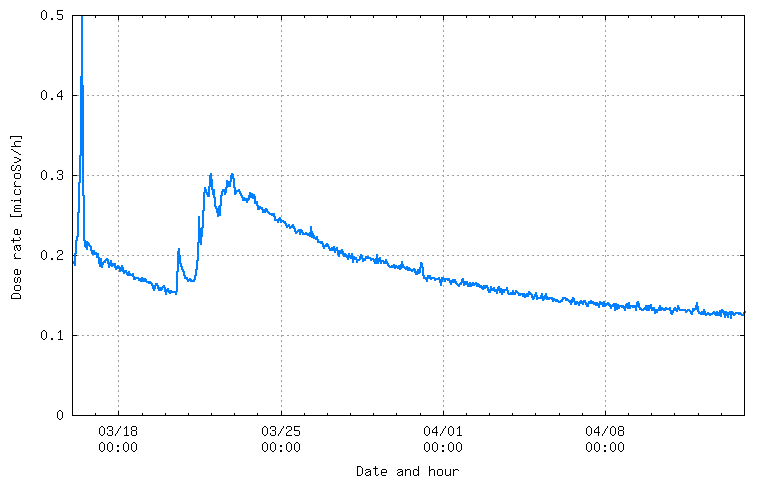
La Radioactivité de Fukushima à Tokyo

http://rcwww.kek.jp/norm/display_all60min.png

Diagramme de la mesure de la radioactivité de l'air ambiant. Elle est réalisée au KEK, un synchrotron installé à Tsukuba, la grande université technologique située au nord de Tokyo. Les physiciens ont décidé de mettre en ligne sur le web et en temps réel leur mesure.

Que montre ce diagramme ? La radioactivité naturelle du lieu est en moyenne de 0,07 à 0,09 microsievert. Sur ce graphique la valeur maximale est un peu inférieure à 0,5 microsievert par heure. Mais le signal est lissé sur une heure, si l'on mesure le signal minute par minute, le maximum a pu monter à 1,1 microsievert sur cette durée. Le maximum a été atteint dès le 16 mars. Avec un pic important, suivi d'une chute. Ensuite, du 21 au 23 mars, on observe une remontée vers 0,3 microsievert par heure, suivi d'une lente mais régulière diminution vers 0,18 microsievert par heure.
L'exposition moyenne, en France, à la radioactivité naturelle est en moyenne de 2,4 millisieverts par an, soit 2400 microsieverts.
Cette mesure confirme que l'essentiel de la radioactivité émise dans l'atmosphère par l'accident l'a été au début. Que les vents en ont rapporté une partie vers l'ouest et le sud vers le 20 mars. Et que les précautions prises pour la mégalopole de Tokyo (interdiction de boire l'eau de ville lorsqu'elle dépassait la limite légale pour les enfants) sont plus que raisonnables.

samedi 2 avril 2011

Barack Obama's American Birthright

Editor's note: This article includes language some readers may consider inappropriate. 

This bland, unnecessary and even cowardly cover-your-ass advisory -- placed above the text of Alex Johnson's report for MSNBC.com, dated 14 March 2008 and entitled "Controversial Minister Leaves Obama Campaign: Presidential candidate condemns words but not ministry of former pastor" -- speaks volumes about the current state of affairs in this country. What could be inappropriate in days as shameful as these? Is "inappropriate" different from "offensive"? For whom is the "language" potentially inappropriate? In whose eyes might it be so?
In this short report, Johnson reveals and yet manages to bury the simple fact that Rev. Jeremiah Wright retired "last month" from the Trinity United Church of Christ in Chicago, that is to say, almost a month before video recordings of his sermons were placed on-line, and then pounced upon and sensationalized by the Fox News Channel. This "scandal" has in fact already ended (if it ever really began) and is now being artificially kept alive (re-created moment by moment) by those who are opposed to Barack Obama's candidacy for the Democratic nomination and convinced they have found their means of bringing him down. At the end of Johnson's article, we finally encounter the "language" that "some" might find "inappropriate." There are two such passages. Here's the first:
"Barack knows what it means, living in a country and a culture that is controlled by rich white people," Wright said on Christmas Day of last year. "Hillary can never know that. Hillary ain't never been called a [N-word]!"
The second passage immediately follows and brings the article to a close. (Note the incorrect use of the present tense.)
"In another sermon, delivered five days after the 9/11 attacks, Wright seems [sic] to imply that the United States had brought the terrorist violence on itself.
'We bombed Hiroshima, we bombed Nagasaki, and we nuked far more than thousands in New York, and we never batted an eye,' Wright says [sic]. 'We have supported state terrorism against the Palestinians and black South Africans, and now we are indignant because the stuff we have done overseas is brought right back to our own front yards.'
In a later sermon, Wright revisits the theme, declaring: 'No, no, no, not God bless America -- God damn America!'
And so the "inappropriate" "language" is the word hidden under that weird, evasive typographical trick (N-word?! which N-word? Oh, you must mean "nigger"), and the phrase "God damn America." Bind them together, these suspicions about Obama's race and patriotism, and you've got a perfect cross on which to nail him.
On its own, "[N-word]" -- not the slur itself, mind you, but a deformed stand-in for it -- shows us just how far away "we" (or at least the corporate media that speaks in the name of "the public") are from having an honest conversation about race in America in 2008. Which is another way of illustrating just how far we are from having an honest conversation about America itself, because "America" is nothing if not a "racial country," a country dominated by racial histories, identities, relations and prejudices, even if the American nation (the State and the media) deny it. This is a country made possible by the coast-to-coast conquest and permanent occupation of Native American lands, which -- over the course of 250 years, but especially after the Civil War -- entailed the deaths of some 60 or 70 million indigenous people; and this is a nation founded upon -- the USA is a political economy created and massively enriched by -- slavery, which entailed the seizure, forcible transport and systematic exploitation and abuse of millions of Africans over the course of virtually those same 250 years.
There is nothing "inappropriate" or offensive about either the wording or the ideas behind Rev. Wright's remarks, that is, unless you find the truth about life in America inappropriate or offensive. Rich white people do indeed own and control this country and its popular culture; Hillary Clinton has probably never been called a nigger, nor has she ever been called anything similar ("WASP" has no sting and "cracker" is pretty stale; "monster," "bitch" and "cunt" don't count here because they are not specific to life in America); the American state did indeed bring the terrorist violence of September 11th upon itself (its called "retaliation"); the American state did indeed kill millions of innocent people by bombing Hiroshima and Nagasaki (one city was already one too many); the American state has certainly allowed its ally and proxy, Israel, the freedom to do almost anything it wants in its low-intensity war against the Palestinian people; the Reagan Administration did indeed consider the African National Congress to be a "Communist" group and thus supported apartheid instead; many people were indeed "indignant" over the September 11th attacks, as if their outrage were more a matter of principle ("how dare they!") than a direct response to the concrete instance (using hijacked planes as missiles, and thus forcibly turning their passengers into suicide-bombers).
No doubt there are millions of black and white people in America, and hundreds of millions of people of all races and ethnicities worldwide, who believe these statements -- and the others attributed to Rev. Wright concerning the origins, proliferation and predominantly black and poor victims of HIV, crack cocaine, et. al -- to be both true and expressed in suitably outraged, passionate language. For them, Rev. Wright -- like Ward Churchill and Malcolm X before him, both of whom spoke frankly about America's chickens coming home to roost, and paid terrible prices for doing so -- has a firm grasp on reality, on the facts of living in America. Perhaps (hopefully!) these millions of people also see the common thread in Rev. Wright's statements: modern America never admits responsibility, never takes the blame; it never feels guilty or ashamed of its actions; it never confesses nor begs for forgiveness. Its conscience is always clear. And so, Jeremiah Wright declared, America is guilty of hubris, of thinking itself to be as flawless and innocent as God himself!
The other side of this hubristic innocence is a stunning amnesia. As Greil Marcus points out in The Shape of Things to Come: Prophecy and the American Voice (2006), Americans have been saying "God damn America" (in the form "may God damn America if . . ." or "God will damn America if . . .") ever since, indeed, even before there was an America. For example: "The laws of impartial Providence may avenge our injustice upon our posterity," George Mason wrote in a 1774 statement to the Virginia legislature on the question of slavery. "I tremble for my country," Thomas Jefferson wrote in Notes on the State of Virginia (1781), "when I reflect that God is just, that his justice cannot sleep forever." Now engraved on the walls of the Jefferson Memorial, these words mean that God will damn America if it fails to abide by, live up to and make good on the promises it has made itself and the rest of the world, precisely because those promises are divine promises, intended to bring about a divine result: a kind of heaven on earth ("life, liberty and the pursuit of happiness"). On the Fourth of July, 1829, the abolitionist William Lloyd Garrison worried about America's damnation should the anti-slavery movement be defeated: "woe to the safety of this people! [...] Blood will flow like water [...] The terrible judgments of an incensed God will complete the catastrophe of republican America." And in his Second Inaugural Address, President Lincoln declared, "Yet, if God wills that it [the civil war] continue until all the wealth piled by the bondsman's two hundred and fifty years of unrequited toil shall be sunk, and until every drop of blood drawn with the lash shall be paid by another drawn with the sword, as was said three thousand years ago, so still it must be said 'the judgments of the Lord are true and righteous altogether.'"
Greil's speculation is that Lincoln "finally went too far, rendering judgment in words so violent and unforgiving it is sometimes hard to credit that they survive at all, let alone that they remain chiseled in huge letters on an inside wall of a giant monument, where they sit, to be read and considered, to frighten or inspire, or gazed at as if they were no more than a verbal statue and just as mute" (pages 13-14). Ever since the Second Inaugural Address, Greil notes "few politicians or preachers have dared to suggest that the nation was made to judge itself in a court the country would have to convene over and over again" (page 14). The very idea that, in America, "passing [...] judgment on America [...] is everyone's burden and liberation" -- which was "once public and part of common discourse, something to fight over in flights of gorgeous rhetoric and blunt plain speech" -- "has long since become spectral; it is now cryptic [...] The drama in which the country judges itself, asks itself what it really is, what it is for, measures the promise by its betrayal and the betrayal by the promise has been played out most intensely in art" (page 8). But today, now that the Fox News Channel has decided to sensationalize the videotapes of the Reverend Jeremiah Wright judging America worthy of being damned by God, the idea that "passing [...] judgment on America [...] is everyone's burden and liberation" has returned with a vengeance.
The truly striking thing is that everyone who is permitted to speak in the spectacle -- everyone from the Rev. Jesse Jackson to Bill O'Reilly to Hillary Clinton; politicians and news commentators of all ideological stripes; even Barack Obama himself -- has hastened to publicly denounce Rev. Wright's comments as "divisive," "unacceptable," "incendiary," even "hate speech" and "anti-American." Not one person has spoken up in his defense. Some have pointed out that Billy Graham is an anti-Semite and yet has been the spiritual advisor of every American President since Richard Nixon, and that Pat Robertson blamed September 11th on the homosexuals, the pro-abortionists and the ACLU, and yet this did not discredit or ruin the careers of the many Republican politicians who have embraced him. But no one has called on the press and the public to denounce the "hate speech" of Graham and Robertson; no one has denounced the hypocrisy of denouncing Rev. Wright; no one has proposed that Rev. Wright be forgiven.
To his credit, Barack Obama has refused to extend his condemnation from the remarks to the man who made them. Alex Johnston quotes him as saying that Rev. Wright is someone "I've known for 17 years, [who] helped bring me to Jesus, helped bring me to church. I strongly condemn [Wright's statements, but] I would not repudiate the man. He's been preaching for 30 years. He's a man who was a former Marine, a biblical scholar, someone who's spoken at theological schools all over the country. That's the man I know. That's the man who was the pastor of this church."
But this obviously valid and just distinction between the retired pastor's spiritual role in Obama's life and the political opinions that the Reverend expressed from the pulpit (whether or not Obama himself was in attendance is irrelevant) -- a distinction that clearly echoes the separation of Church and State so prized by the Founding Fathers and so despised by the religious right-wing -- was not enough for the "red meat" right-wing news reporters and commentators on Fox News, talk radio and various blogs. They continued to re-run the footage of the Rev. Wright saying "God damn America," and tried to find and exploit apparent contradictions or omissions in Barack's last few public statements on the "scandal" (at a radio station on Thursday and MSNBC's Countdown with Keith Olbermann on Friday).
And so Obama scheduled a special speech on race relations in America for Tuesday, 18 March. In a stroke of genius -- whether it was the genius of chance or the genius of Barack's team, I don't know -- the speech was arranged to be given at the National Constitution Center in Philadelphia, Pennsylvania, across the street from the hall in which The Declaration of Independence was signed 232 years ago. (The next major Democratic Party primary election will take place in Pennsylvania on 22 April.) To make it seem that the historical resonances and implications were all their idea, and owed nothing to the Spirit of Place or the Mind of History, Obama's campaign staff stage filled the stage with eight American flags, four on each side of their man. As always, Barack would look tall and thin, kind of Lincolnesque, the former state senator from Illinois now running for president; but this time he would be like Lincoln coming to Philadelphia, the birthplace of the American experiment in democracy, to attend to pressing matters concerning the nation's destiny.
"In calm and direct language that at once affirmed the authority of the speaker and the speaker's respect for his listeners" (Greil Marcus, 22, writing about John Winthrop's 1630 speech "A Modell of Christian Charity"), Barack Obama addressed the country for about 30 minutes, during which he covered a lot of ground. He repeated his condemnations of Rev. Wright's remarks (all of them, no distinctions among them made) and he repeated his refusal to condemn or repudiate the man himself. His remarks are worth quoting at some length:
Like other predominantly black churches across the country, Trinity embodies the black community in its entirety -- the doctor and the welfare mom, the model student and the former gang-banger. Like other black churches, Trinity's services are full of raucous laughter and sometimes bawdy humor. They are full of dancing, clapping, screaming and shouting that may seem jarring to the untrained ear. The church contains in full the kindness and cruelty, the fierce intelligence and the shocking ignorance, the struggles and successes, the love and yes, the bitterness and bias that make up the black experience in America. And this helps explain, perhaps, my relationship with Reverend Wright. As imperfect as he may be, he has been like family to me. He strengthened my faith, officiated my wedding, and baptized my children. Not once in my conversations with him have I heard him talk about any ethnic group in derogatory terms, or treat whites with whom he interacted with anything but courtesy and respect. He contains within him the contradictions -- the good and the bad -- of the community that he has served diligently for so many years.
I can no more disown him than I can disown the black community. I can no more disown him than I can my white grandmother -- a woman who helped raise me, a woman who sacrificed again and again for me, a woman who loves me as much as she loves anything in this world, but a woman who once confessed her fear of black men who passed by her on the street, and who on more than one occasion has uttered racial or ethnic stereotypes that made me cringe.
These people are a part of me. And they are a part of America, this country that I love.
In this extraordinary passage, Barack Obama uses inclusiveness as his method, and thus quietly highlights his differences from Rev. Wright's prophetic taste for rejections, denunciations and exclusions. He moves easily from the level of the national ("other predominantly black churches across the country") to the level of the community (Trinity) to the level of the individual (Rev. Jeremiah Wright, who "contains within him the contradictions -- the good and the bad -- of the community that he has served diligently for so many years"). At each level, Obama's clear eyes see "kindness and cruelty, the fierce intelligence and the shocking ignorance, the struggles and successes, the love and yes, the bitterness and bias that make up the black experience in America." Thus, in addition to seeing the differences and contradictions that fracture that experience at all three levels, Obama also sees the unities between the country as a whole and the individual American, the individual American and his or her own community, and the community and the country. But rather than impersonalizing the individual, as was done (classic case) in Ronald Reagan's vision of a re-united America, Obama's vision humanizes the national.
Then Obama does an extraordinary thing: he pairs Rev. Wright with his grandmother. "I can no more disown him than I can disown the black community. I can no more disown him than I can my white grandmother [...] who once confessed her fear of black men who passed by her on the street, and who on more than one occasion has uttered racial or ethnic stereotypes that made me cringe." But he doesn't create this pairing to equate the two, to suggest that one justifies or excuses the other. He pairs them to include them in himself, to show that they are included in him: "These people are a part of me." Then Obama pairs them up again: "And they are a part of America, this country that I love." And then it hits you: "it is a single American, claiming his or her birthright, as a single body standing in, if only for a moment, for all other Americans" (Marcus, 15). Barack Hussein Obama is not merely an American (an assertion that would be contested by those who would have us believe that Obama is in fact not a Christian, but a Muslim, more attached to Kenya that to Illinois); Barack Hussein Obama is America.
But it is the speech's beginning, the context for his undeniable claim upon his birthright, that shows why Barack Obama is certainly a more interesting, thoughtful and thought-provoking presidential candidate than either Hillary Clinton or John McCain, and possibly someone who would make a great president. He already has the great distinction of having given the best speech on race since the time of Abraham Lincoln. "We the people, in order to form a more perfect union," Barack quoted, without going on to finish the "Preamble" to the Constitution of the United States: "We the People of the United States, in Order to form a more perfect Union, establish Justice, insure domestic Tranquility, provide for the common defence, promote the general Welfare, and secure the Blessings of Liberty to ourselves and our Posterity, do ordain and establish this Constitution for the United States of America."
For Obama, the most important words in this text are "more perfect union." America was not perfect at the time of its founding; nor will it be perfect soon. "The document they produced was eventually signed but ultimately unfinished. It was stained by this nation's original sin of slavery, a question that divided the colonies and brought the convention to a stalemate until the founders chose to allow the slave trade to continue for at least twenty more years, and to leave any final resolution to future generations." But both the "document" of the "Preamble" and America itself had the potential to be more perfect, better, that is to say, better each time. But "potential" is not everything. "And yet words on a parchment would not be enough to deliver slaves from bondage, or provide men and women of every color and creed their full rights and obligations as citizens of the United States. What would be needed were Americans in successive generations who were willing to do their part -- through protests and struggle, on the streets and in the courts, through a civil war and civil disobedience and always at great risk -- to narrow that gap between the promise of our ideals and the reality of their time." And so if America is "perfectable" or capable of being perfected, it can only be perfected slowly, gradually, painfully, with the passing of generations. Barack doesn't simply "include" both Rev. Wright and his grandmother: he improves them, he moves them towards perfection, even though none of them will ever get there. In Philadelphia, Barack said,
The profound mistake of Reverend Wright's sermons is not that he spoke about racism in our society. It's that he spoke as if our society was static; as if no progress has been made; as if this country -- a country that has made it possible for one of his own members to run for the highest office in the land and build a coalition of white and black; Latino and Asian, rich and poor, young and old -- is still irrevocably bound to a tragic past. But what we know -- what we have seen -- is that America can change. That is true genius of this nation. What we have already achieved gives us hope -- the audacity to hope -- for what we can and must achieve tomorrow.
At the end of his speech, turning our sight from the past to the future, Obama declared, "[...] the comments that have been made and the issues that have surfaced over the last few weeks reflect the complexities of race in this country that we've never really worked through -- a part of our union that we have yet to perfect." And though better than it was in 1972, when Jeremiah Wright became Trinity's pastor, "our union" is far from perfect today. As a matter of fact, "we've been stuck in [a racial stalemate] for years"; perhaps since 1994, or as long ago as 1981; in either case, "race is an issue that I believe this nation cannot afford to ignore right now." And Obama went on to sketch out what's overdue, which is immediate, dedicated action on segregated schools, legalized discrimination, and the lack of economic opportunity for black men and women. And he suggested that America cannot change or progress, or even face its current list of prodigious tasks, if the "current" stalemated state of race relations doesn't change first.
These are reformist, not revolutionary demands, I know, just as I know that the American movement towards self-perfection could only get started in and through revolution and warfare, not the gradual reform of British colonial society. But Obama's presence on the stage of American history, even if it is only reformist, temporary and insufficient, is a breath of fresh air in the winds of this polluted nation. I have personally felt compelled, despite my refusal to vote for or support any candidate for any office, to make sure that there is at least some reflection on what Obama said, that his ideas are not simply and completely ignored, and the language that he used is not praised and dismissed as "rhetorical." I can certainly understand that, for some Americans, March 2008 and the prospects of November 2008 are reminiscent of November 1992, when "Bill Clinton's election -- or the prospect that twelve years of rule by those who never admitted to doubt, for whom American promises were catchphrases and betrayals were always those of someone else, might be ending -- gave many people a kind of breathing space, where they could discover that the country was still daring them to act out the country's drama for themselves" (Marcus, 15).
 
Note added 30 April 2008: two days ago, Rev. Wright broke his silence and called Barack Obama's bluff. Referring to Obama's 18 March speech in Philadelphia, Wright said, "If Senator Obama did not say what he said, he would never get elected. Politicians say what they say and do what they do based on electability, based on sound bites, based on polls." The next day, Obama responded like a politician: he broke completely with his former spiritual advisor. "I am outraged by the comments that were made and saddened over the spectacle that we saw yesterday," he pontificated. "The person I saw yesterday was not the person that [sic] I met 20 years ago." Too bad for Barack: we are now unreserved in our support for the Rev. Dr. Jeremiah Wright. Now there's a man qualified to be President of the United States of America!

Fissures sur le réacteur n°2 de Fukushima

L'opérateur de la centrale nucléaire de Fukushima-Daiichi, au Japon, a annoncé samedi la découverte d'une fissure sur une structure en béton du réacteur n°2 qui pourrait expliquer l'origine d'une fuite radioactive dans l'océan Pacifique. Trois semaines après l'accident nucléaire déclenché par le séisme de magnitude 9 et le tsunami du 11 mars, qui ont fait 28.000 morts et disparus, le Premier ministre Naoto Kan s'est rendu pour la première fois dans une région sinistrée et dans la zone d'évacuation de 20 km autour de la centrale. Selon la Tokyo Electric Power (Tepco), opérateur de Fukushima, la radioactivité mesurée à l'endroit de la fissure est de 1.000 milliSieverts par heure. Les barres de combustible sont toujours en surchauffe et des niveaux élevés de radiation sont mesurés en mer. Une radiation 4.000 fois supérieure à la limite légale a été détectée au large de la centrale. Le groupe cherche parallèlement à recruter des "liquidateurs" à qui il propose jusqu'à 3.500 euros la vacation pour se rendre dans les zones les plus exposées à la radioactivité afin de procéder à des réparations.

Selon les premiers prélèvements effectués par Tecpo jeudi l'eau de mer à 300 mètres au sud de la centrale présente un taux d'iode radioactif 4385 fois supérieur à la norme légale. La situation à Fukushima "reste très grave", en conclut vendredi l'Agence internationale de l'énergie atomique (AIEA).

http://www.criirad.org

EN FINIR AVEC LA SIDERATION ET LA PEUR


“La prochaine fois, ce sera peut-être la bombe virale d’un biohackeur qui anéantira tout le personnel d’une centrale, avec les mêmes conséquences qu’à FUKUSHIMA “

Cela a peut être eu lieu dans la catastrophe de FUKUSHIMA, le virus Stuxnet en circulation dans les centrales nucléaires iraniennes, chinoises etc, munies de logiciels de maintenance Siemens a peut être déstabilisé le fonctionnement des centrales japonaises... aussi.
LA QUESTION IGNORÉE PAR TOUS LES MÉDIAS :
POURQUOI LA VAGUE DE 15 a 25 mètres du TSUNAMI DU 11 mars est elle de couleur NOIRE ???
La routine du désastre
Les nouvelles de la catastrophe de la centrale atomique de Fukushima au Japon tournent en boucle. Face à un désastre sans précédent, les médias commentent en direct les nouvelles du nucléaire qui a l’air de n’en faire qu’à sa tête.
Les infos fusent, c’est un véritable bombardement, mais rien ne perce.
Non, aucun enseignement ne sera tiré. Une telle catastrophe ne pourrait pas arriver ici. Les journalistes, les experts et les politiciens discutent séisme et tsunami, s’accordant sur le caractère exceptionnel de la situation de cette île lointaine. Ces raclures en profitent même pour vendre la fameuse fiabilité des installations françaises qui seraient les plus sûres du monde. Sans jamais rappeler que n’importe quelle erreur humaine peut produire le même résultat partout. Sans jamais préciser que n’importe où en France, nous habitons toujours à moins de 100 km d’une installation nucléaire.
Ils se garderont bien de préciser que derrière la catastrophe, c’est un quadrillage et une gestion militaires qui s’instaurent. En plus d’être contaminé, chacun sera en permanence contrôlé, testé, mesuré, surveillé, et déplacé dans des zones où toute liberté, initiative individuelle, et parcelle d’autonomie, auront disparu sous le règne kaki.
Leur propagande préfère faire croire que ces opérations désespérées d’acheminement d’eau, de sable, que leurs mesures martiales de confinement et leurs pauvres distributions de pastilles d’iode ont pour but notre santé. Pourtant si c’était vrai, un petit nombre de pays ne la mettraient pas en péril permanent en s’engageant dans la voie du nucléaire. Derrière cette monstruosité se cachent d’énormes intérêts économiques et stratégiques. Depuis le début, nucléaires civil et militaire sont complètement imbriqués, et l’histoire du développement de cette technologie est entièrement liée à un jeu mortifère entre puissants.
La routine du désastre est déjà présente, à travers la multiplication quotidienne de ce que ces autruches du nucléaire qualifient par euphémisme d’«incidents». Ils nous promettent par exemple maintenant de vérifier l’état actuel des 58 réacteurs du territoire français, mais ne disent bien sûr rien des problèmes insolubles posés par les déchets radioactifs qui dorment sous nos pieds dans près de 1000 sites, ni des nombreux cancers et leucémies que subissent celles et ceux qui vivent aux abords des installations nucléaires. Sans compter toutes les barbouzeries au Niger et au Gabon, où Areva exploite la main d’œuvre locale en la condamnant à une mort lente en même temps que toutes celles et ceux qui habitent près des mines d’uranium.
Le pouvoir fait comme si tout cela était inéluctable, essayant tant bien que mal d’éviter le pire, mais surtout sans jamais interroger ce qui a été et qui reste encore un choix.
En vrai, on pourrait tout de suite se passer du nucléaire et du monde qui le produit. Les écologistes et autres ONG à la sauce verte ne parlent que d’une pseudo «sortie» du nucléaire d’ici 20 ou 30 ans, pour ne pas froisser leurs soutiens étatiques et leurs potentiels électeurs. En véritables sauveteurs du capitalisme, ils espèrent occuper un rôle de contre-experts pour être associés à sa gestion actuelle.
Que d’images spectaculaires de la centrale en feu, que de mises en scène de «sauvetages» épiques, que d’angoissants nuages radioactifs doit-on gober sans réagir ! Que de débats stériles entre politiciens sur les différentes alternatives pour répondre aux appétits dévorants du développement industriel, que de prétendus discours raisonnables pour des mesurettes qui ne remettent rien en cause ! Autant de mascarades pour recouvrir d’un voile opaque l’aberration du nucléaire. Il est grand temps de briser la vitrine qu’il représente et de mettre fin à toute cette merde.
Derrière l’horreur de cette catastrophe sans précédent dont on a pas fini de compter les morts, c’est l’acceptation à un niveau mondial du nucléaire qui se joue.
L’État tient le rôle du pompier pyromane. Il est celui qui a mis en place tout ce merdier et qui fait maintenant mine d’être le protecteur, le seul à pouvoir assurer la sécurité des populations.
Jamais le monde tel-qu’il-est-et-qu’il-ne-faut-surtout-pas-renverser n’avait trouvé de meilleur garant. Un possible figé qui, à part connaître l’empoisonnement et la militarisation de cette planète, verra à peu près toujours les mêmes en haut et les autres en bas, les mêmes qui «savent» et les autres qui suivent.
Ce qu’ils craignent réellement, ce n’est pas le désastre en cours et à venir, ce ne sont pas non plus les appels de leurs sbires citoyennistes à une «meilleure» gestion de l’existant, tous parlent encore la même langue du mal nécessaire.
Ce qu’ils ont par contre à redouter ce sont des luttes contre le nucléaire et le monde qui va avec.
Parce qu’ils nous voudraient tous cobayes résignés et désemparés. Parce que la liberté commence par le sabotage de ce monde qui nous détruit.
Ni cobayes ni moutons, 19 mars 2011.
Tract distribué ces jours-ci à Paname

vendredi 1 avril 2011

POISON D'AVRIL

Le Premier ministre japonais a expliqué vendredi que les Japonais ne couraient aucun risque d'être exposés à des taux dangereux de radioactivité s'ils suivaient les conseils des autorités.
Vu le 11 mars 2011
"Un ministre japonais a évoqué la possibilité d'un relâchement de vapeur d'eau contaminée afin de diminuer la pression dans le bâtiment du réacteur concerné, le N°2. Dans ce cas, la radioactivité disséminée resterait à des valeurs relativement faibles, car il ne s'agit que de la contamination externe au réacteur et non à celle du combustible nucléaire du cœur."
"Ce n'est pas la première fois qu'un séisme a des conséquences importantes sur les centrales nucléaires japonaises. En juillet 2007, un séisme de magnitude 6,6 s’est produit à proximité immédiate de la centrale nucléaire de Kashiwazaki-Kariwa (située sur la côte ouest de l’île d’Honshu). La route passant à côté de la centrale s'était ouverte sous le choc du séisme, d'intensité supérieure à celle escomptée par les géologues japonais pour le dimensionnement des système antisismique. Les réacteurs de la centrale, à l'arrêt comme en fonctionnement, avaient toutefois bien réagi, les sûretés automatiques les mettant en sécurité. "
Tout va Bien ! 
source 
En ce qui concerne la destinée du complexe de Fukushima après l'accident, les principaux experts russes de l'industrie nucléaire s'accordent pour dire que l'histoire de Tchernobyl ne se reproduira pas. A Fukushima, la situation est sous contrôle et le pire est derrière nous, car on a réussi à éviter la fusion d'une zone active. Cependant, l'évolution future dépendra de la rapidité du gouvernement japonais à rétablir l'électricité dans les réacteurs.
"On peut dire que les conséquences de "Fukushima-1" ont étés réduites au minimum", a conclu l'agence d'information du site Lenta.ru. Toutefois, de nombreux experts estiment que le plus fiable reste de fermer les unités endommagées.
Selon un expert d'Eco-Institut, Michael Seiler, la suite dépend également du développement de la fusion éventuelle des barres de combustible des réacteurs. L'un des pires scénarios consiste : une expulsion de matières nucléaires. Une vaste zone serait ainsi contaminée. Les Japonais ne pourraient qu'espérer que le vent pousse le nuage radioactif vers l'océan Pacifique.
Nezavisimaya Gazeta s'accorde sur cette analyse et ajoute que dans le pire des cas, un combustible nucléaire en fusion pourrait percer la coque et gagner la terre, infectant selon lui le sol et l'eau pendant des centaines d'années dans un rayon de 500 km.
source
Tsunami : les recherches pour trouver des corps continuent. Des milliers de soldats japonais et américains ont débuté vendredi une vaste campagne de recherche de corps le long de la côte nord-est du Japon, frappée il y a trois semaines par un gigantesque tsunami. Les armées des deux pays alliés ont déployé 120 avions et hélicoptères, ainsi que 65 navires, pour chercher les 16 441 personnes portées disparues après la vague géante qui a dévasté la côte Pacifique de la grande île de Honshu, et qui sont probablement décédées. « Nous allons nous concentrer sur le long des côtes, les embouchures des fleuves et les territoires encore recouverts d'eau de mer », explique un responsable des Forces japonaises d'autodéfense, l'armée japonaise. La fouille ne pourra couvrir toutefois une zone de 30 km autour de la centrale accidentée de Fukushima, où le niveau de radiation est dangereux. Jusqu'à un millier de corps n'ont pas été ramassés autour de cette centrale. Selon un bilan provisoire, près de 28 000 personnes sont mortes ou portées disparues lors de cette catastrophe.
 

Non-lieu requis pour Pellerin le menteur

Ni Coupable Ni Responsable

À la tête de l'Autorité de protection nucléaire en 1986, le scientifique est accusé d'avoir minimisé les retombées radioactives de Tchernobyl sur la France.

En pleine catastrophe nucléaire au Japon, la responsabilité du Pr Pierre Pellerin dans la gestion qu'eut la France des retombées du nuage de Tchernobyl voilà vingt-cinq ans, est étudiée par la justice. Une étiquette colle à la peau du Pr Pellerin : celle d'avoir été l'homme qui aurait déclaré que «le nuage s'est arrêté à la frontière». S'il n'a en réalité jamais prononcé cette phrase, celui qui était alors le directeur du Service central de protection contre les rayonnements ionisants (SCPRI), est accusé d'avoir minimisé l'impact des retombées radioactives sur la France et des risques encourus par la population. Une attitude qui, selon les parties civiles, serait responsable d'une hausse des cancers de la thyroïde.

Deux associations (l'Association française des malades de la thyroïde et la Criirad, la Commission de recherche et d'information indépendantes sur la radioactivité) souhaitent que soit reconnue la responsabilité du scientifique. Elles accusent le patron du SCPRI d'avoir volontairement transmis des communiqués partiels et partiaux tendant à rassurer la population entre le 30 avril et le 5 mai 1986. Les parties civiles s'appuient sur une expertise judiciaire ayant conclu en 2005 que «la restitution par le SCPRI des informations concernant la contamination radioactive du territoire, aussi bien aux autorités décisionnaires qu'au public, n'a été ni complète ni précise et que, certaines valeurs ont été occultées».

«Nous sommes très en colère. Nous souhaitons que le mensonge d'État prenne fin. Nous sommes pour la transparence. Aujourd'hui, est-on sûr de ce qui se passe à Fukushima ? interrogeait jeudi Chantal Garnier, coprésidente de l'Association française des malades de la thyroïde qui regroupe 3 700 personnes. En 1987, les médecins diagnostiquent à cette femme aujourd'hui âgée de 61 ans un cancer de la thyroïde qu'elle attribue à la catastrophe de Tchernobyl. Nous reprochons au Pr Pellerin d'avoir menti. Il aurait fallu éviter de consommer des fruits et légumes frais. En cas de non-lieu, nous irons plus haut.» 

Tchernobyl: Il manquent 600 millions d'euros  pour la construction du nouveau sarcophage

Les autorités ukrainiennes ont tiré la sonnette d'alarme, jeudi 31 mars, lors d'une visite de Tchernobyl organisée pour la presse, soulignant qu'il manquait actuellement environ 600 millions d'euros sur un total de plus d'un milliard et demi pour financer les travaux en vue de la construction du nouveau sarcophage à la centrale nucléaire accidentée. "Le programme complet de travaux est actuellement évalué à 1,540 milliard d'euros, dont 990 millions d'euros pour le seul sarcophage", a souligné Volodymyr Kholocha, le directeur de la zone d'exclusion. Il a expliqué que les dépenses annexes concernaient les travaux de préparation, de décontamination du site, et l'installation de systèmes de sécurité nucléaire. "Des dons d'environ 940 millions d'euros ont déjà été annoncés et rassemblés dans le fonds de Tchernobyl ; le manque s'élève donc à environ 600 millions d'euros", a ajouté M. Kholocha. 

Archives du blog